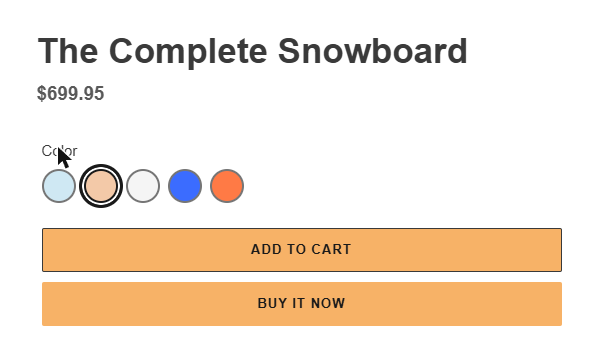
Before and after
Fixing a customised Shopify theme
Colour swatches, a newsletter popup, focus, labels and contrast: from 69 errors to 0.
We find and fix the accessibility problems that stop people with disabilities from buying in your Shopify store. You pay only after you have checked the fixes.
Every button, option and popup should work with a keyboard and tell a screen reader what it does.
Accessibility is not a niche problem. It affects a large share of your customers, and most online stores still get it wrong.
of adults in the US have some type of disability: more than one in four potential customers.
Source: CDC
of the top one million home pages have detectable accessibility failures, with 56 errors per page on average.
Source: WebAIM Million 2026
digital accessibility lawsuits were filed in the US in 2025. 69% of them targeted online stores.
Source: UsableNet
of companies sued over website accessibility in 2025 had annual revenue under $25 million.
Source: EcomBack data via TestParty
businesses using "one-click" accessibility widgets were still sued in 2023–2024.
Source: TestParty
independent Shopify stores we checked had accessibility errors, up to 79 on a single product page.
Source: our own research
A short, plain-language overview. It is not legal advice.
Courts have applied the Americans with Disabilities Act to online stores. People who cannot use a website can sue the business behind it, and most cases end in settlements that also require fixing the site. Many lawsuits are filed against small stores.
Since 28 June 2025, the European Accessibility Act requires online stores and other digital services in the EU to be accessible. National authorities enforce it; in Ireland it is the CCPC. Micro-businesses (fewer than 10 staff and up to €2 million turnover) that provide services are exempt.
No guarantees. We are not lawyers, and nobody can honestly promise that a website will never be challenged. What we do is remove real barriers for real customers and give you a written record of exactly what was fixed.
Most problems do not come from the Shopify theme itself but from customisations and apps added later.
Size and colour choices that cannot be selected with a keyboard or announced by a screen reader.
Newsletter and discount popups that trap or lose keyboard users and cannot be closed without a mouse.
Cart, wishlist, gallery and social icons that a screen reader can only call "button" or "link".
Sale badges, announcement bars and buttons that are too faint to read, while keeping your brand colours.
Product photos and banners without text descriptions, and "Shop now" buttons that are not real links.
Reviews, subscriptions, sliders and quick-view windows from third-party apps that screen readers cannot use.
Simple, written, and low risk for you.
Send your store's address. Within 2 business days you get the three most important problems, with screenshots.
If you want them fixed, you get the full list and a fixed price before any work starts.
We fix a duplicate of your theme. Your live store is untouched and we never need your password.
You preview every change and publish when you are happy. Then you pay.
Optional. New products and apps can bring new problems; we catch and fix them.
How we find problems, how we fix them, and what we see on real stores.
Colour swatches, a newsletter popup, focus, labels and contrast: from 69 errors to 0.
Every store had problems, and most of them came from apps rather than the theme.
A second before and after example, focused on the parts of the store where people actually buy.
No one can honestly guarantee that. We remove real barriers, follow the WCAG 2.2 AA guidelines that courts and regulators refer to, and give you a written record of what was fixed. That puts you in a much better position, but it is not a legal guarantee.
No. You approve a standard Shopify collaborator request that gives us access to your themes only. You can remove it at any time.
Only where it has to. We keep your design and brand colours, and mostly change things people cannot see: labels, structure and keyboard behaviour. Any visible change is shown to you before it goes live.
Every store is different, so we quote a fixed price after the free check, before any work starts. You pay only after you have checked and published the fixes.
Widgets add a toolbar on top of the site but do not fix the code underneath. The US Federal Trade Commission fined one widget company $1 million in 2025 for overstating what its product does, and stores using widgets continue to be sued.
PLACEHOLDER. A real client's words go here: what was wrong with their store, how the work went, and what changed after the fixes.
Email us your store's address. Within 2 business days you get the three most important problems with screenshots. No obligation, no sales calls.
danil@reachablecart.com